Lowercase Letter Tracing: Why Small Letters Are Harder and What Helps
By Sadia Afrin, Early Childhood Educator · 4 min read
Capital letters are mostly straight lines. Lowercase letters are smaller, curvier and several look alike. No wonder they cause trouble.
Capital letters are made mostly of straight lines and big shapes. Lowercase letters are smaller and curvier, and several look like each other. No wonder they cause trouble.
Why lowercase is harder
- Smaller targets need finer control.
- More curves and circles.
- Look-alikes: b, d, p and q use the same shape in different positions.
- Different heights: some letters sit on the line, some have tails below it, some reach up.
The tricky six
The free pack focuses on d, b, p, q, g and y. They are the letters children most often reverse or confuse.
What helps
- Start with the curve. For b, d, p and q, teach the "ball and stick" idea: a round ball and a straight stick. Where the stick sits changes the letter.
- Use stories. For example, "b" has its stick first, then its belly, like a bat and a ball.
- Use one letter at a time. Don't teach b and d on the same day.
- Trace big, then small. Large air or finger tracing first, then pencil on the line.
- Use a tail-and-line guide. Show that g, p, q and y drop below the line.
- Go slow. Reversals are very common in the early years. Keep practice short and positive.
🎁 Free download
Tricky Lowercase Letters
Six pages from My ABC Adventure: D, B, P, Q, G and Y, each with the small letter to trace, a find-and-circle grid and an animal to colour.
⬇️ Download free PDF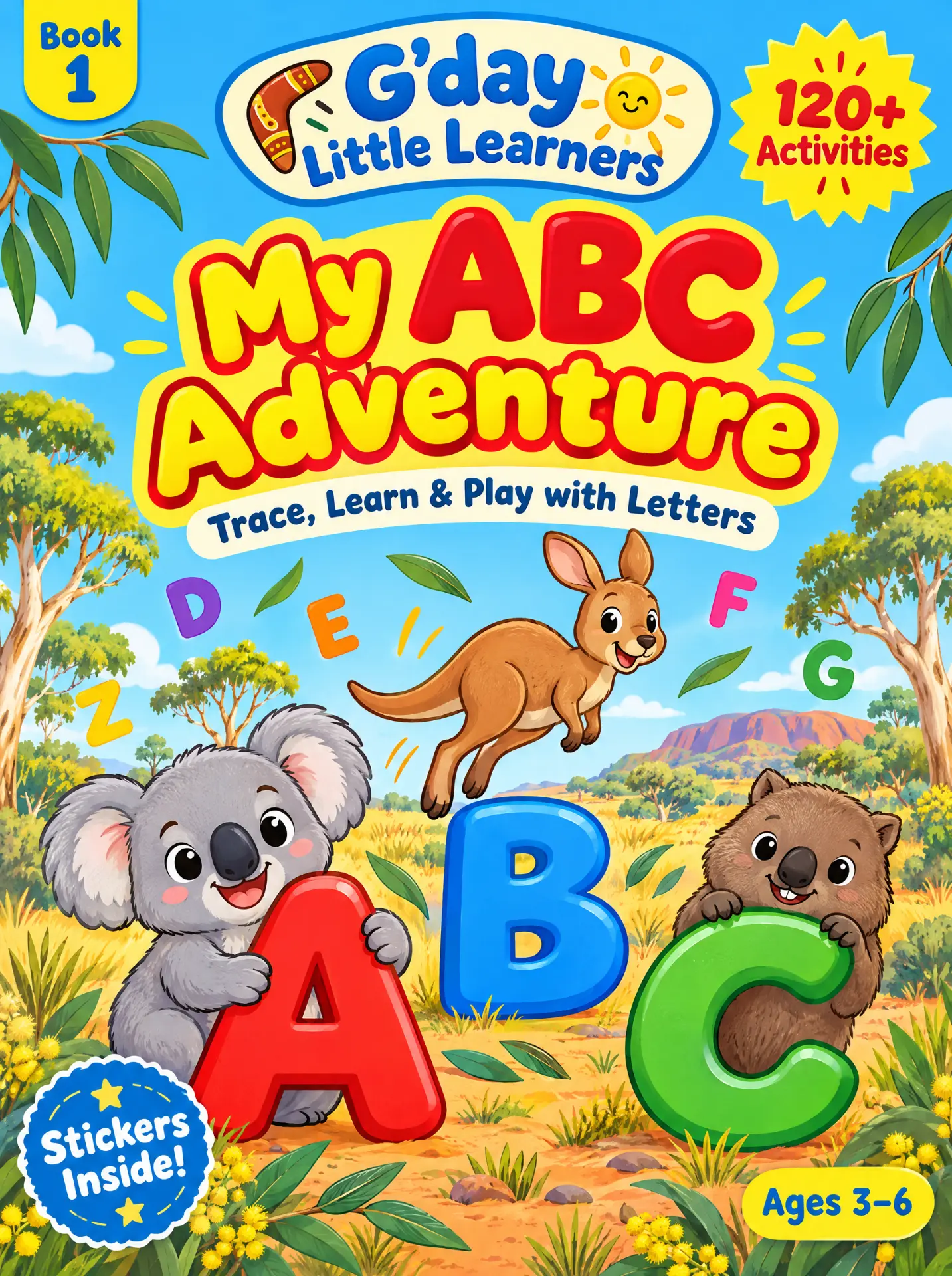
Ready for the whole alphabet?
My ABC Adventure has a full page for every letter, with one Australian animal each, plus matching games, missing letters, mazes and a name page. Ages 3–6.
Want 600+ ready-to-print activities like these?
All five G'day Little Learners books, instant download.
🛒 Get all 5 books – $39