Phonics for Kids: A Parent's Guide to Letter Sounds (Start Here)
By Sadia Afrin, Early Childhood Educator · 6 min read
Phonics links letters to the sounds they make. Here is where to start, which sounds to teach first and games to play at home.
Phonics is the link between letters and the sounds they make. When children know that the letter s says "sss", they can start to read and spell words, not just recite the alphabet. If you're not sure where to begin, this guide is for you.
What is phonics?
Phonics teaches children that written letters stand for spoken sounds, and that words are built by blending those sounds together. Hearing c-a-t and blending it into "cat" is the first step towards reading.
Sounds before names
Teach the sound a letter makes before its name: "sss" for s, not "ess". Sounds are what children blend into words. Letter names can come along the way. Keep sounds short and clean. Sounds like "mmm" and "sss" can be stretched, while "t" and "p" should stay quick and soft, without an extra "uh" on the end.
Which sounds first?
Many programs start with a small group of common letters that make lots of simple words. A popular first set is s, a, t, p, i, n, followed by m, d, g, o, c, k. With just s, a, t, p, i and n you can already build words like sat, pin, tap and pan. Check what your child's school uses and follow that if you can.
A simple routine for each sound
- Say the sound. Show the letter and say its sound clearly.
- Find it. Look for things that start with the sound: s for sun, sock and snake.
- Trace it. Trace the letter while saying the sound.
- Play with it. Do a quick game such as I spy, a sound hunt or a sound bag.
- Review. Go back over the sounds you've learned, a few each day.
Games to play at home
- I spy with sounds: "I spy something that starts with mmm."
- Sound bag: put three or four small objects in a bag and say the first sound of each as you pull them out.
- Sound hunt: find five things around the house that start with the sound of the day.
- Sound hop: write sounds on sheets of paper and hop to the one you call out.
How long should it take?
Short and often wins. Five to ten minutes a day is plenty for ages 3 to 5. Every child moves at their own pace, so go slowly and keep it playful.
Where does phonics lead?
Once a child knows a handful of sounds, they can start blending simple three-letter words such as sat, pin and dog. After that come rhyming, ending sounds and a few common sight words. Phonics Fun with Joey follows this order, with Joey the kangaroo as your child's guide.
🎁 Free download
My First Sounds Chart
A one-page A4 chart with 12 first sounds (s, a, t, p, i, n, m, d, g, o, c, k) and three example words for each. Stick it on the fridge.
⬇️ Download free PDFQuick answers
What age should children start phonics?
Many children are ready between ages 3 and 4, once they enjoy songs, rhymes and looking at letters. There's no rush, so follow your child's interest.
Do I need to know the sounds myself?
A little practice helps. Listen to how a teacher or an audio guide says each sound, and keep your version short and clear.
Should I teach letter names too?
Yes, but sounds usually come first for reading. Children pick up the names along the way.
Ready for the sounds and first words?
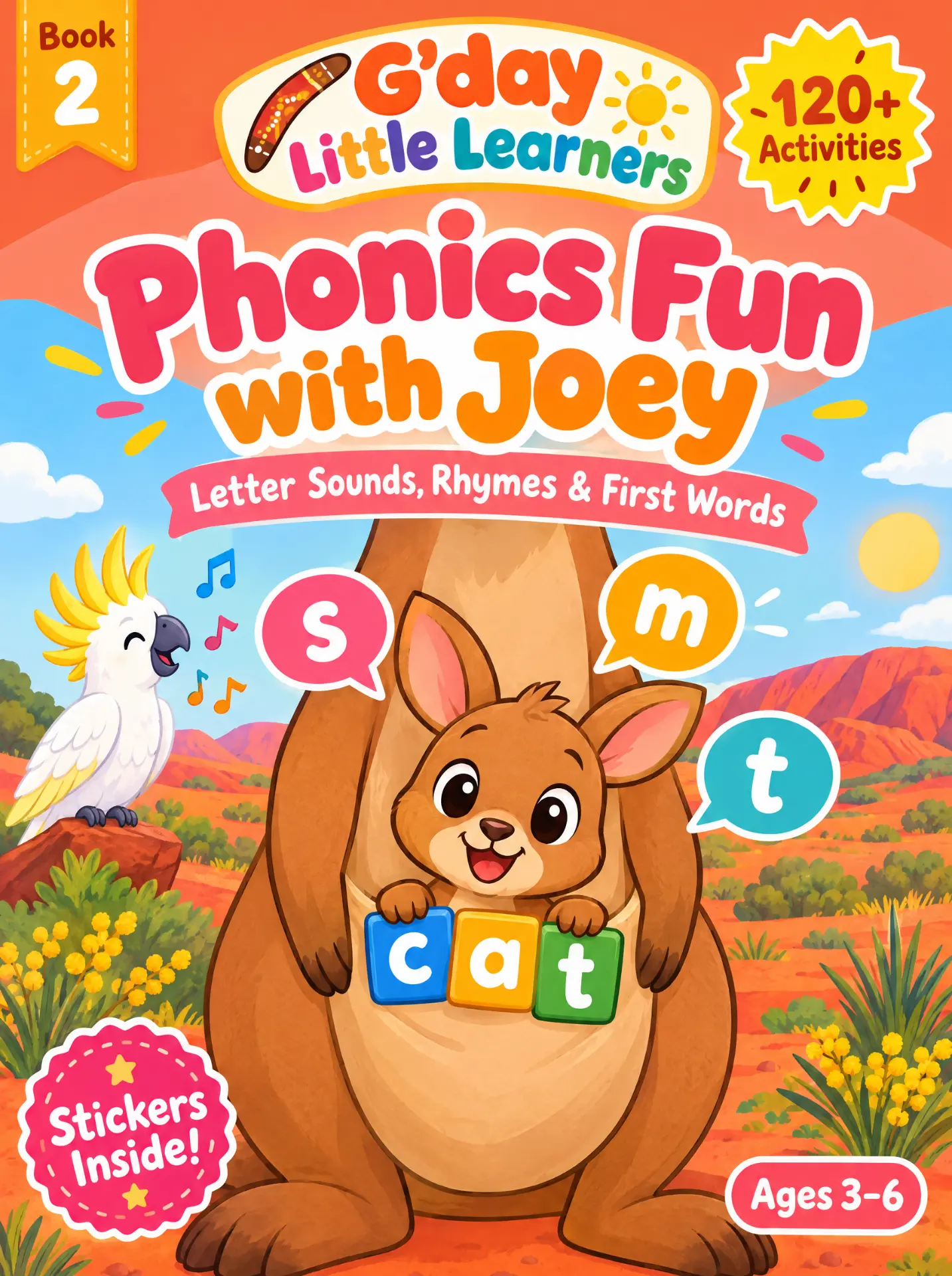
Phonics Fun with Joey has 120 activities: letter sounds, beginning sounds, rhyming, simple three-letter words, ending sounds, sight words and syllable clapping. Joey the kangaroo guides ages 3–6.
Want 600+ ready-to-print activities like these?
All five G'day Little Learners books, instant download.
🛒 Get all 5 books – $39